
Introduction to the Tool/Technique
Gap analysis is a technique used in internal audit to compare an organization’s current performance or controls against a desired standard—whether that’s a policy, regulation, or best practice. This tool helps auditors highlight discrepancies (gaps) between what is and what should be, paving the way for actionable recommendations. It’s often used in the evaluation and conclusion phase of an audit, where findings must be distilled into root causes and improvement areas.
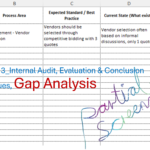
Template: SKU.4011_Internal Audit, Evaluation & Conclusion Techniques, Gap Analysis
A practical way to conduct and document a gap analysis is through an Excel-based Gap Analysis Matrix. This template includes:
Process Area: The area under review (e.g., procurement, payroll, IT access).
Expected Standard: The benchmark or policy that defines what “should be.”
Current State: What is actually happening in practice.
Gap Identified: Description of the mismatch.
Root Cause: Reason for the gap, if known.
Risk/Impact: Potential consequences of the gap.
Recommendation: What should be done to address the issue.
Responsible Person and Target Date: Accountability and timeline.
Application Example at ACME Corp.
During a procurement process audit at ACME Corp., Internal Auditor Auren was asked by CEO Liora to ensure procurement practices were transparent and aligned with good governance. Project Manager Aven suspected that informal vendor selections were driving costs up.
Auren used the Gap Analysis Matrix to evaluate vendor selection practices. He discovered that although ACME’s policy required at least three vendor quotations per purchase, most procurement decisions were made based on single informal quotes. Interviews with staff revealed that no formal policy document existed, and there was a lack of training.
Auren documented the following in the matrix:
Gap: Competitive bidding not consistently followed.
Root Cause: No formal procurement policy or monitoring.
Impact: Increased risk of favoritism and unnecessary cost.
Recommendation: Draft and implement a formal procurement policy requiring at least three quotes per transaction, and train staff accordingly.
Liora endorsed the recommendation and tasked Aven to roll out the policy within six weeks. The gap analysis not only pinpointed the issue but also guided leadership on corrective steps, improving control and cost-effectiveness.
Template: SKU.4011_Internal Audit, Evaluation & Conclusion Techniques, Gap Analysis