
Introduction to the Tool/Technique
Benchmarking is a powerful audit technique that compares an organization’s performance metrics to industry standards or peers. It helps auditors identify performance gaps, inefficiencies, or best practices worth adopting. Internal audit uses benchmarking during the evaluation and conclusion phase to provide data-driven insights that go beyond compliance—highlighting opportunities for strategic improvement. Benchmarks can be internal (year-on-year), functional (within the same industry), or best-in-class (across industries).
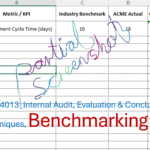
Template: SKU.4012_Internal Audit, Evaluation & Conclusion Techniques, Benchmarking
A good format for benchmarking in audit work is a structured Excel-based Benchmarking Matrix with the following key columns:
Metric / KPI: What is being measured (e.g., cycle time, cost per unit).
Industry Benchmark: The target or average from peers or standards.
ACME Actual: The audited company’s current result.
Gap: The variance between ACME and the benchmark.
Reason for Gap: Observations or explanations behind the deviation.
Implication: Risks or inefficiencies resulting from the gap.
Recommendation: Suggested improvement or control.
Responsible Person and Target Date: Accountability and timeline.
Application Example at ACME Corp.
At ACME Corp., Internal Auditor Auren was tasked by CEO Liora to assess procurement efficiency. Auren consulted benchmarking data from a leading supply chain institute and found that the industry average for procurement cycle time (from requisition to purchase order) was 10 days. At ACME, the average was 18 days—a clear inefficiency.
Using the benchmarking matrix, Auren documented:
Gap: +8 days longer than industry norm.
Reason: Manual approvals, bottlenecks in vendor communication.
Implication: Project delays, higher holding costs, and vendor dissatisfaction.
Recommendation: Implement a digital procurement workflow with defined SLAs for vendor response and approval automation.
Project Manager Aven acknowledged the issue and proposed piloting the new workflow in Q3 2025. Liora approved budget reallocation for automation tools. Through benchmarking, Auren not only identified the issue but influenced tangible process upgrades at ACME.
__________
Template: SKU.4012_Internal Audit, Evaluation & Conclusion Techniques, Benchmarking