T&Ts Series F, Internal Audit, Reporting & Communication, Episode F2 — Scorecards: Visual Tools to Summarize Audit Results or KPIs

1. Introduction to the Tool/Technique In internal audit, presenting complex findings in a clear, visual format is essential—especially when reporting to senior management. That’s where Audit Scorecards shine. Scorecards distill audit results, control ratings, or key performance indicators (KPIs) into a simple, visual summary. This helps leaders like CEO Liora and project owners like Aven […]


Read More →

Categories: T&T, Internal Audit

T&Ts Series F, Internal Audit, Reporting & Communication, Episode F1 — Audit Report Template

1. Introduction to the Tool/Technique One of the most powerful tools in internal audit reporting is the standardized Audit Report Template. These templates help internal auditors like Auren clearly communicate findings, recommendations, and conclusions to stakeholders such as the CEO, Liora, and project managers like Aven. A consistent structure improves clarity, reduces review time, and […]

Read More →

Categories: T&T, Internal Audit

T&Ts Series E, Internal Audit, Evaluation & Conclusion Techniques, Episode 07— Materiality and Risk Rating

1. Introduction to the Tool/TechniqueMateriality and Risk Rating is a critical evaluation method used in internal audit to determine the significance of audit findings. It supports prioritization by assigning ratings based on impact and likelihood. This allows stakeholders like CEOs and project leads to focus on the most pressing risks while ensuring compliance and performance […]

Read More →

Categories: T&T, Internal Audit

T&Ts Series E, Internal Audit, Evaluation & Conclusion Techniques, Episode 06— Control Effectiveness Evaluation

T&Ts Series E, Internal Audit, Evaluation & Conclusion Techniques, Episode 06: Control Effectiveness Evaluation – Determines if Controls Meet Objectives 1. Introduction to the Tool/TechniqueControl Effectiveness Evaluation is a core component of internal audit methodology used to assess whether a control is both well-designed and operating effectively. In simpler terms, auditors ask: “Is the control […]

Read More →

Categories: T&T, Internal Audit

T&Ts Series E, Internal Audit, Evaluation & Conclusion Techniques, Episode 05— Analytical Procedures – Identify trends, anomalies, or variances.

1. Introduction to the Tool/TechniqueAnalytical procedures are a powerful internal audit technique used to evaluate financial or operational data by studying plausible relationships between data sets. Auditors use these procedures to detect anomalies, outliers, or unexpected trends that could indicate errors or misstatements. These procedures are especially useful in the evaluation and conclusion phase of […]

Read More →

Categories: T&T, Internal Audit

SKU.4014_Internal Audit, Evaluation & Conclusion Techniques, Substantive Testing

Food for Thought: Substantive testing is a core audit technique that verifies the accuracy and integrity of financial and operational records by directly examining transactions, balances, or disclosures. Unlike compliance testing, which checks whether procedures are followed, substantive testing confirms whether what’s reported is actually correct. This technique is essential during the evaluation and conclusion phase […]

Read More →

Categories: T&T, Internal Audit

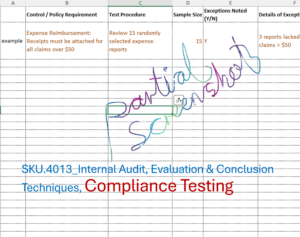
SKU.4013_Internal Audit, Evaluation & Conclusion Techniques, Compliance Testing

Food for Thought:Compliance testing is a key audit method used to determine whether internal controls, processes, or policies are being followed as intended. Unlike substantive testing, which focuses on numbers and results, compliance testing focuses on behavior and adherence. Internal auditors typically use this technique when evaluating controls around areas like HR, finance, procurement, and […]

Read More →

Categories: T&T, Internal Audit

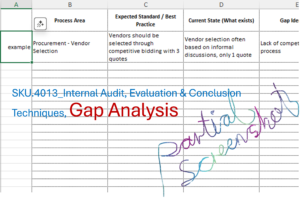
SKU.4011_Internal Audit, Evaluation & Conclusion Techniques, Gap Analysis

Introduction to the Tool/TechniqueGap analysis is a technique used in internal audit to compare an organization’s current performance or controls against a desired standard—whether that’s a policy, regulation, or best practice. This tool helps auditors highlight discrepancies (gaps) between what is and what should be, paving the way for actionable recommendations. It’s often used in […]

Read More →

Categories: T&T, Internal Audit

T&Ts Series E, Internal Audit, Fieldwork and Evidence Collection, Episode 09 — Reperformance

Introduction to the Tool/TechniqueReperformance is a fundamental audit technique that involves the independent execution of procedures or controls originally performed by others. It serves as direct evidence of control effectiveness or process accuracy. Internal auditors use reperformance to verify calculations, validate process steps, and confirm compliance with documented procedures. This technique is especially useful in […]

Read More →

Categories: T&T, Internal Audit